The problem
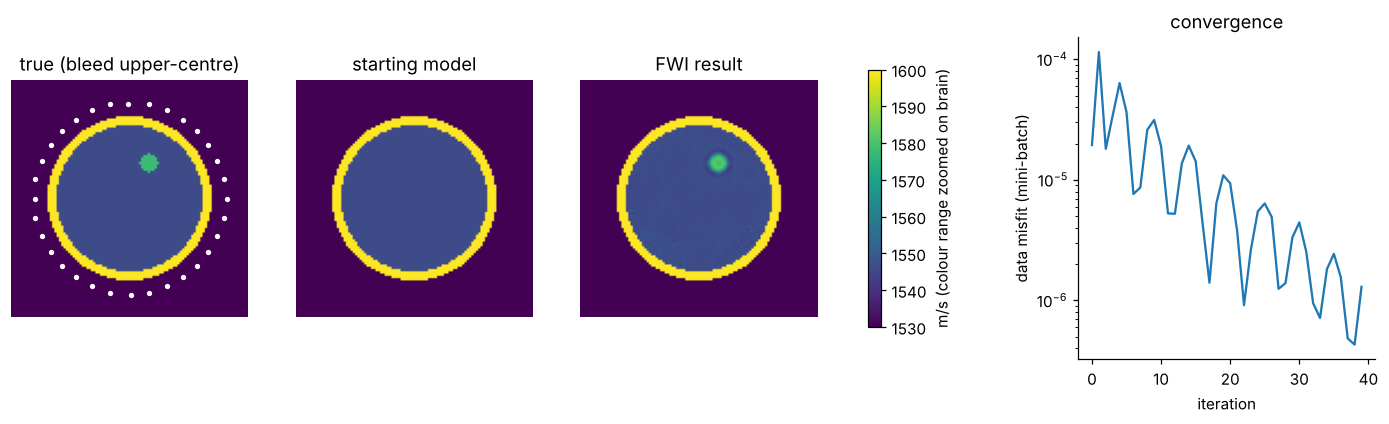
A stroke caused by bleeding has to be told apart from a clot before treatment, and that takes a CT or MRI scanner most ambulances and rural hospitals don't have. Guasch et al. (npj Digital Medicine, 2020) showed an ultrasound helmet can image the brain with full-waveform inversion, but reconstruction needs thousands of wave simulations, and over 95% of the compute is the wave simulation itself.
What we built
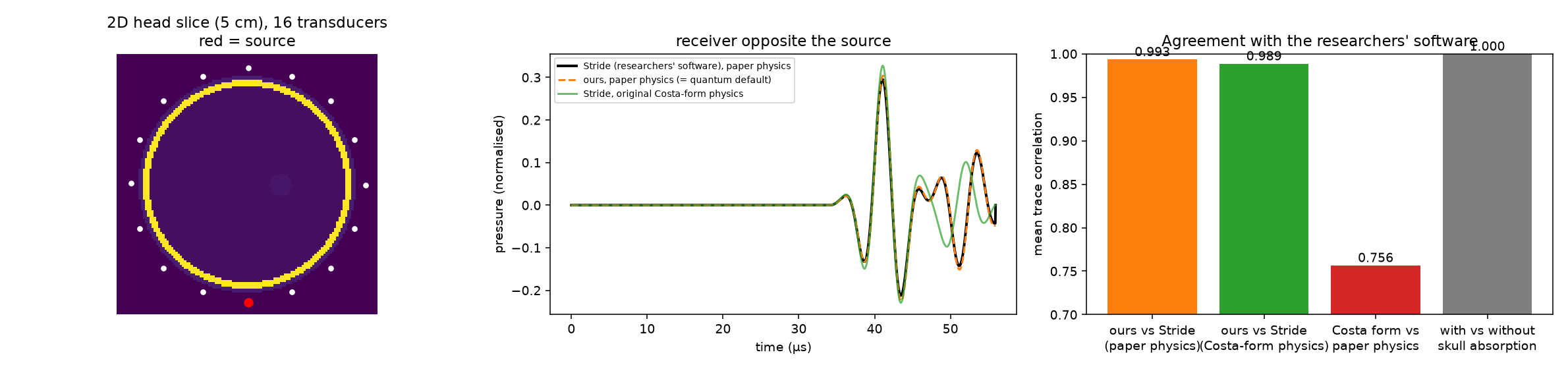
The acoustic wave equation can be rewritten as a Schrödinger equation, and quantum computers natively run that kind of evolution. We built that step as Qiskit circuits for a head with water, scalp, skull, brain and a bleed, then checked them against the classical answer in 1D, 2D and 3D, and against the paper group's own solver, Stride.
On real IBM hardware
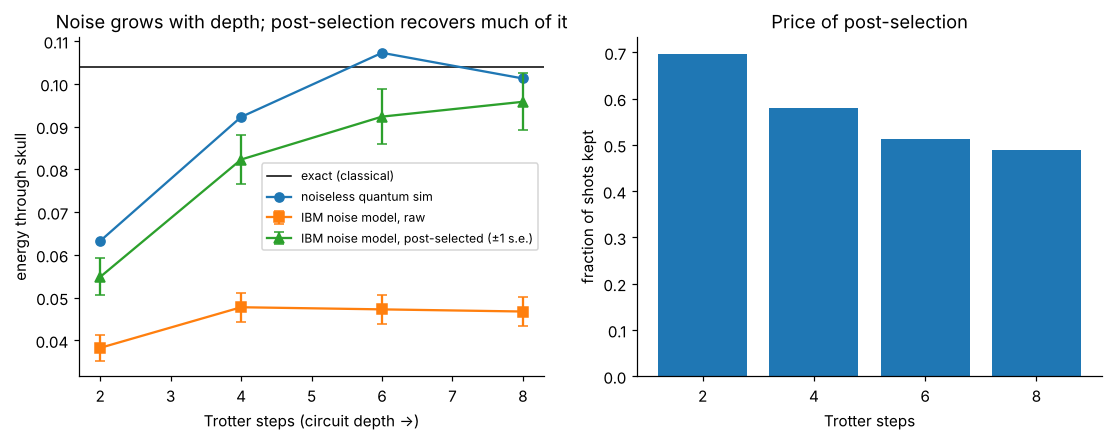
On ibm_marrakesh, the raw chip keeps only about 13% of the signal: 0.013 against an exact answer of 0.104. The physics conserves the excitation number, so any shot that doesn't show exactly one excitation is known to be bad and can be dropped. That post-selection recovers 0.081 ± 0.011, and every point lands within 2σ of the ideal circuit. The cost is shots: the chip keeps about 16%, where its noise model predicted 49%.
Honest limits
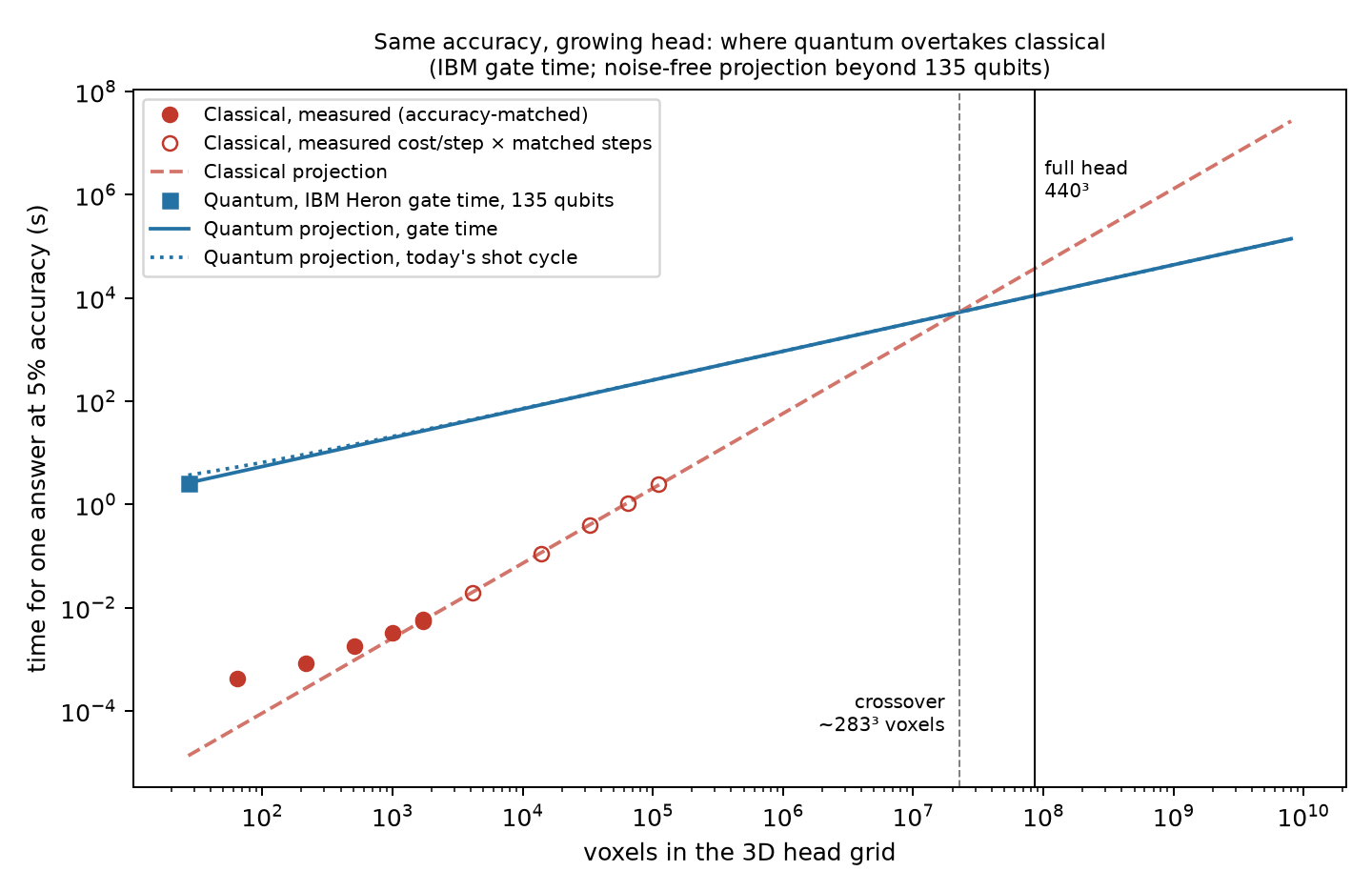
One run on Heron took 6.3 µs against 695 µs classically, about 110× per run, but that was a small test circuit. At equal accuracy, the crossover comes at about 283³ voxels and a full head is about 3.3× faster, and that's a projection. Classical still wins at today's sizes: there's no end-to-end or clinical quantum advantage yet.
| Limit | Number | What fixes it |
|---|---|---|
| Noise | Raw hardware keeps 13% of the signal | Error correction; until then, post-selection |
| Qubits | Unary full head: ~3×10⁸ qubits. Compact: 29 qubits but ~10¹³ CZ | Fault-tolerant hardware |
| Readout | One full round by sampling: ~10¹³ shots, ~114 years at today's rate | Clinical questions that need only a few numbers out |
| Physics | Unitary evolution has no absorption (~2% signal effect) | Non-unitary methods |